What Is a Glass Company and What Does It Do?

A glass company does far more than produce transparent sheets for windows. It transforms raw materials, including silica sand, soda ash, and limestone, into useful glass products. Its work may include design, melting, forming, tempering, coating, inspection, packaging, and installation.

A glass company can serve construction, automotive, food packaging, healthcare, electronics, and interior design. One factory may produce insulated window units, while another creates laboratory bottles or decorative panels. The equipment differs, but precision remains essential. Furnaces often operate above 1,500°C. Small temperature changes can affect clarity, strength, and thickness.

Dr. Alicia Durán, a respected glass scientist and author, describes glass as “a material connecting science, technology, and art.” Her observation captures the industry’s character. Glass requires chemistry, engineering, skilled operation, and visual judgment. A clean production floor still depends on human decisions.

Quality control is visible in practical details. Workers inspect edges for chips, measure thickness, and test resistance to heat or impact. They also examine tiny bubbles, scratches, and uneven coatings. These defects may seem minor. In a building façade, they can reduce safety, appearance, or energy performance.

The industry is not flawless. Manufacturing consumes substantial energy, and recycling systems vary between regions. Some companies improve efficiency through furnace upgrades, renewable energy, and closed-loop material recovery. Yet progress can be uneven. A responsible glass company must therefore balance performance, cost, safety, and environmental responsibility. Understanding these responsibilities reveals what the industry actually does, beyond the simple image of making glass.
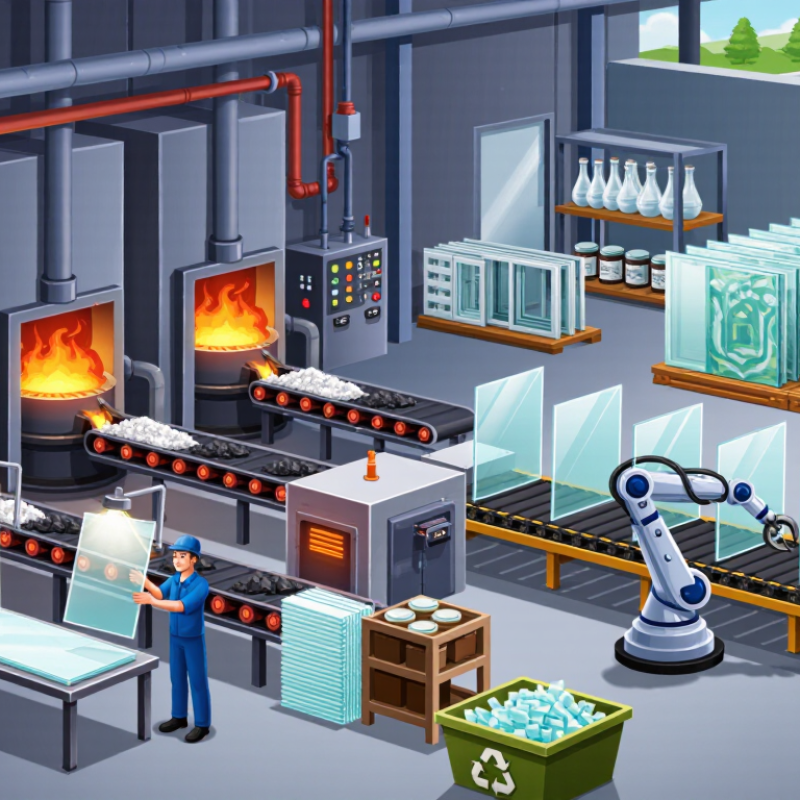
What Is a Glass Company and What Does It Do?

Defining a Glass Company: Manufacturers, Processors, Distributors, and Installers

What Is a Glass Company and What Does It Do?

Defining a Glass Company: Manufacturers, Processors, Distributors, and Installers

A glass company may handle one stage or manage an entire project. Its role depends on its equipment, staff, and technical experience. Manufacturers create glass from raw materials inside high-temperature furnaces. They control thickness, clarity, strength, and surface quality during production. Some produce standard sheets, while others make specialized glass for buildings, vehicles, or interiors.

Processors transform those sheets into useful components. They may cut, edge, drill, temper, laminate, or apply protective coatings. Precision matters here. A small measurement error can affect the final fit. Distributors purchase finished glass and coordinate storage, packaging, and delivery. Their work protects fragile products from scratches, moisture, and sudden impact. They also help customers match specifications with available materials.

Installers measure openings, prepare supports, and secure the glass at the site. They use suitable seals, setting blocks, and fastening methods. Experienced installers also inspect edges before fitting each piece. A reliable glass company explains who performs every task. It provides product details, handling guidance, inspection records, and clear project communication. On real projects, these details prevent avoidable delays.

The boundaries can overlap. A processor may also distribute products, while an installer may offer basic fabrication. That is useful, but it can complicate responsibility when something goes wrong. Strong coordination remains essential. Even skilled teams can miss a detail when drawings, measurements, or delivery notes change late.

Main Industry Segments: Container, Flat, Fiber, and Specialty Glass

What Is a Glass Company and What Does It Do?

Main Industry Segments: Container, Flat, Fiber, and Specialty Glass

A glass company transforms sand, soda ash, limestone, and recycled glass into useful products. It controls melting temperatures, chemical balance, forming speed, and cooling conditions. Small changes can create visible defects, such as bubbles, cracks, or uneven thickness. Skilled technicians inspect samples, test strength, and monitor production equipment throughout the day. Recycling is also important because clean cullet can reduce raw material use and furnace energy demand.

Container glass becomes bottles and jars for food, medicine, and beverages. Engineers adjust the design for safe filling, transport, and repeated handling. Flat glass serves buildings, vehicles, furniture, and solar equipment. Its surface must remain clear and consistent, especially when coatings are applied. Fiber glass is drawn into thin strands for insulation, reinforced materials, and sound control. The strands feel delicate but can provide impressive strength when combined with resin.

Specialty glass includes products designed for heat resistance, optical performance, laboratory use, or electronic applications. These materials often require tighter chemical control than ordinary glass. A reliable company documents each batch, maintains traceable testing records, and follows applicable safety standards. However, no process is flawless. A perfect surface is difficult to guarantee, and production teams must investigate failures rather than hide them. Real expertise grows through measurement, maintenance, and honest review of unexpected results.

How Glass Is Made: 1,500°C Melting and the Float-Glass Process

A glass company does more than shape transparent sheets. It controls raw materials, furnace chemistry, forming equipment, cooling, inspection, and delivery. It starts with heat. Silica sand, soda ash, limestone, and recycled glass are carefully weighed into a batch. The mixture enters a furnace near 1,500°C, where it becomes a uniform molten liquid.

The European Commission’s Best Available Techniques Reference Document for the Manufacture of Glass reports that melting can consume more than 75% of a plant’s total energy. That figure explains why furnace design, insulation, combustion control, and cullet use matter so much. Recycled glass usually melts more easily than raw minerals. Industry assessments often estimate a 2–3% energy saving for every 10% increase in suitable cullet. Results vary, though. Contaminated or poorly sorted material can create defects.

In the float-glass process, molten glass flows continuously onto a bath of liquid tin. The glass spreads into a smooth ribbon, while gravity and surface tension help create an even thickness. Rollers then guide it into an annealing lehr, where controlled cooling removes internal stress. The line never sleeps. Cameras and sensors check thickness, bubbles, stones, and scratches before cutting begins. This process appears precise, but it is not effortless. Furnace temperature, batch moisture, tin purity, and cooling speed can shift quality within minutes. A reliable glass company therefore depends on skilled operators, calibrated instruments, documented controls, and constant review.

What Is a Glass Company and What Does It Do? – How Glass Is Made: 1,500°C Melting and the Float-Glass Process

A factual overview of the main activities, materials, temperatures, and production stages used in modern flat-glass manufacturing

Dimension Typical Data or Range What It Means
Primary role of a glass company Manufacturing, processing, finishing, quality control, and distribution A glass company converts mineral raw materials into products for buildings, vehicles, appliances, furniture, containers, and technical applications.
Main raw materials Silica sand, soda ash, limestone or dolomite, and recycled glass cullet Silica forms the glass network; soda ash lowers the melting temperature; limestone and dolomite improve chemical durability and stability.
Batch preparation Measured, mixed, and continuously fed into a furnace Accurate proportions help maintain consistent color, clarity, viscosity, and product performance.
Melting temperature Approximately 1,500°C, depending on composition and furnace conditions The batch becomes a homogeneous molten glass. Industrial furnaces operate continuously and require carefully controlled heat.
Melting and refining High-temperature melting followed by bubble removal and homogenization Refining reduces gas bubbles and helps produce a uniform, optically clear melt before forming.
Float-glass forming medium A bath of molten tin in a controlled atmosphere Molten glass floats on tin, allowing gravity and surface tension to create smooth, parallel surfaces.
Float-bath temperature Approximately 600°C at the hotter entrance, gradually cooling along the bath Controlled cooling allows the glass ribbon to spread, stabilize, and reach the required thickness and flatness.
Standard float-glass thickness Common commercial thicknesses range from about 2 mm to 19 mm Thickness is adjusted by controlling the flow rate, ribbon speed, temperature, and mechanical equipment.
Annealing Gradual, controlled cooling in an annealing lehr Annealing relieves internal stresses so the sheet can be cut, handled, and processed with lower risk of unexpected breakage.
Cutting and inspection Automated scoring, breaking, measurement, and optical inspection Manufacturers check dimensions, surface quality, thickness, optical distortion, inclusions, and visible defects.
Common downstream processing Tempering, heat strengthening, laminating, coating, insulating-glass assembly, and edge finishing Processing can improve safety, thermal performance, solar control, sound insulation, appearance, or resistance to impact.
Tempered glass Heated and rapidly cooled to create surface compression When broken, properly tempered glass generally fragments into many small pieces rather than large, sharp shards.
Laminated glass Two or more glass sheets bonded with a polymer interlayer The interlayer helps hold fragments together after breakage and can also improve acoustic and ultraviolet performance.
Insulating glass units Two or more panes separated by a sealed air or inert-gas cavity The sealed cavity reduces heat transfer and can improve the energy efficiency of windows and façades.
Recycled glass cullet Clean, sorted, crushed glass returned to the batch Cullet can reduce the need for virgin raw materials and generally requires less energy to melt than raw batch ingredients.
Typical end-use sectors Construction, transportation, interior design, appliances, solar equipment, packaging, and laboratory applications Different applications require specific combinations of strength, transparency, thermal resistance, chemical durability, and safety performance.
Key production principle: Glass is melted at roughly 1,500°C, refined to remove imperfections, formed as a continuous ribbon on molten tin, gradually cooled, inspected, and then processed for its intended application.

Quality and Safety Control: ISO 9001, ASTM, and EN Glass Standards

A glass company does more than cut sheets and deliver panels. It manages material selection, processing, testing, and installation support. In a professional factory, quality control starts when raw glass arrives. Staff check thickness, visible defects, edge damage, and documentation. Each batch receives a traceable identity. This detail matters when a complaint appears months later. It also exposes a practical weakness: records are only useful when workers complete them accurately.

ISO 9001 provides a structured quality management system, not a guarantee that every pane is safe. It requires controlled procedures, trained personnel, corrective actions, and evidence of continual improvement. Auditors may review inspection logs, calibration dates, supplier evaluations, and nonconformity reports. On the production floor, a technician might verify furnace settings, measure dimensions, and inspect heat-treated glass under clear lighting. Small deviations can affect strength and fit.

ASTM and EN standards address performance through region- and product-specific requirements. They may cover impact resistance, thermal stress, fragmentation, safety glazing, or dimensional tolerances. A responsible company identifies the correct standard before testing. It should also confirm whether the project requires a particular test method or certification route. Results need controlled samples, calibrated equipment, and clear reports. Mistakes still happen. A mislabeled sample or rushed visual check can undermine reliable data. That is why independent review, documented training, and periodic process checks remain valuable. Clients should request test records, scope details, and traceability information before accepting production claims.

Recycling and Sustainability: 100% Recyclability and 2–3% Energy Savings per 10% Cullet

A glass company makes, processes, and recycles glass products for homes, buildings, and industry. Its environmental role begins with careful collection. Clean glass is crushed into cullet, then mixed with raw materials inside a high-temperature furnace. Glass is 100% recyclable and can return to production repeatedly without losing its basic quality. That circular process reduces demand for sand, soda ash, and limestone. It also limits waste sent to disposal sites.

Cullet delivers a measurable energy benefit. For every 10% increase in cullet, furnace energy use can fall by about 2–3%. The exact result depends on furnace design, moisture, color separation, and contamination levels. Small details matter. A ceramic fragment can damage an entire batch.

A well-run facility checks incoming loads, records furnace performance, and tracks rejected material. These records support reliable claims rather than attractive guesses. Recycling still has weaknesses. Collection systems may be uneven, and transportation can consume extra fuel. That deserves honest review. Better sorting, shorter delivery routes, and cleaner public drop-off points can improve the result.

In practice, sustainability is not a single machine or promise. It is daily control, from the collection bin to the finished container.

About Us

Andy’s Glass & Window Company of Temecula Valley has been servicing the glass, window and door needs of Southern California since the 1970′s. Operating from a 10,700sf commercial building in Murrieta, California, a neighboring town of Temecula.

Contractor’s License #821172

Andy’s Glass & Window Company

25751 Jefferson Ave, Murrieta, CA 92562

(951) 677-7421

sale@johnsonwindowtint.com

Store Hours:
Monday - Thursday 8:00 am - 5:00 pm
Friday 8:00 am - 4:30 pm
Closed Saturday & Sunday

Visit Us

Contact Information
Andy's Glass & Window Company