Buying front doors across borders is not a simple style decision. It is a performance decision.
A door that looks elegant in a showroom may fail in a coastal climate. Salt air can attack exposed hardware. Intense sunlight can fade dark finishes. Heavy rain can reveal weak thresholds and poor drainage. Global buyers must examine dimensions, materials, glazing, security features, energy performance, and installation requirements together.
Gary Katz, a respected door-industry educator, states a practical principle: “A door is only as good as its installation.” That reminder matters when products travel across countries. A carefully engineered slab can still bind, leak, or lose insulation when the frame is poorly fitted. Local wall thicknesses may differ. Hinge positions may not match. Even the handing and swing direction can cause expensive mistakes.
This guide, “10 Front Door Buying Tips for Global Buyers,” focuses on decisions that remain useful beyond photographs and showroom claims. It considers climate exposure, certified performance, packaging, shipping damage, replacement parts, warranty coverage, and installer experience. Buyers should request written specifications and confirm which standards the product follows.
Small details matter.
A sample finish under natural daylight may look different indoors. A smart lock may require regional compatibility. A wide door may also need stronger hinges and careful delivery planning.
Some recommendations will not suit every property. That is the point. Good buying requires checking assumptions, measuring twice, and accepting that attractive front doors are not automatically durable ones.
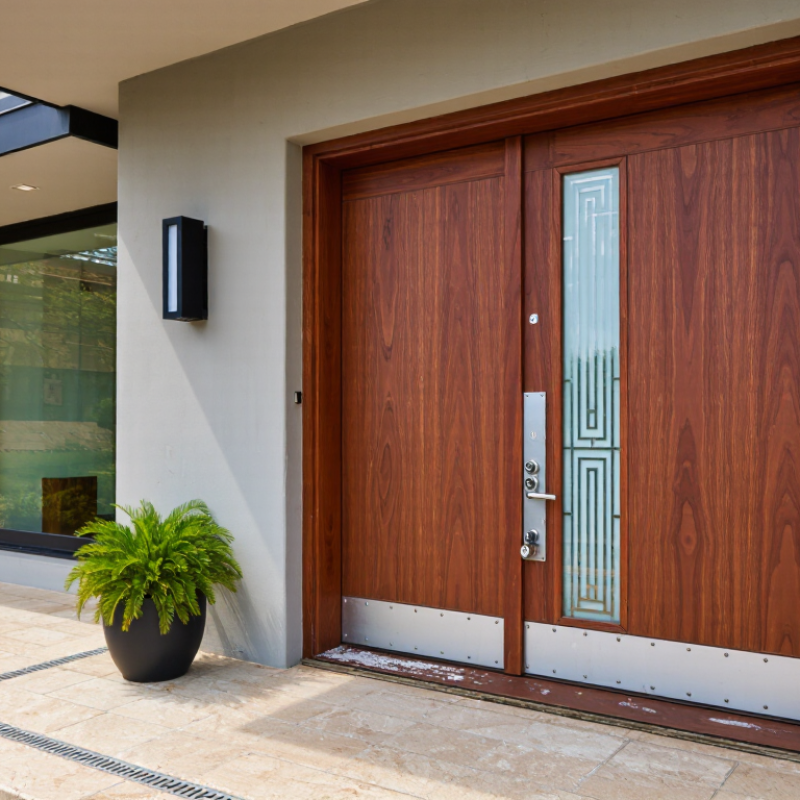
For global buyers, climate classification should guide the front-door specification before appearance. The International Code Council’s eight climate zones range from Zone 1, very hot, to Zone 8, subarctic. Each zone also uses moisture categories: moist, dry, or marine. This matters because a door facing humid coastal air needs different protection from one exposed to freezing winters.
Zone 1 and 2 projects should prioritize solar control, moisture resistance, and reliable weatherstripping. Zones 5 through 8 need insulated cores, tight seals, and reduced thermal bridging. Marine locations demand stronger resistance to wind-driven rain and corrosion.
Code requirements must be checked locally. The ICC climate map is a useful starting framework, not a universal building permit. Confirm U-factor, air leakage, water penetration, wind-load, safety-glazing, and fire-separation requirements with the local authority.
The U.S. Department of Energy reports that windows account for roughly 25% to 30% of residential heating and cooling energy use. A front door is not a window, but the comparison exposes a common weakness: openings can undermine an otherwise efficient envelope.
The U.S. Energy Information Administration’s Residential Energy Consumption Survey also identifies space heating as the largest household energy end use, at about 42% in 2020.
On site, even a well-rated door can perform poorly when the sill pan, threshold, or frame installation is wrong. R-value alone is not enough.
I still see buyers choosing specifications from climate labels without checking local wind and rain exposure. That shortcut deserves more skepticism.
A front door should be judged by tested performance, not appearance alone. When comparing products, examine the NFRC label for three key ratings: U-factor, SHGC, and air leakage. Lower U-factor means better resistance to heat transfer. This matters in cold regions, where indoor warmth can escape through the door.
SHGC shows how much solar heat enters through glazed sections. A lower value may help in hot, sunny climates, while a moderate value can support passive warmth in colder areas. Air-leakage ratings describe how much air passes through gaps around the tested assembly. Lower leakage is generally better. Check the units carefully. Small numerical differences can be misleading.
Ask whether the figures cover the complete door system, including the frame, glass, seals, and threshold. Installation also matters. A highly rated door can perform poorly if the sill is uneven or the weatherstripping is compressed incorrectly. NFRC data is useful, but global buyers should compare its test method with local certification requirements. Ratings are not always directly interchangeable.
Look closely at the climate. A low U-factor is not the only answer. Strong afternoon sun, coastal wind, or frequent rain may change the best choice. I would also inspect corner seals and drainage paths before ordering. These details are easy to overlook. A low leakage number can still disappoint when installation quality is weak. That is worth admitting before purchase.
Illustrative rating profiles based on commonly published NFRC-style performance ranges. Lower U-factor and air leakage generally indicate better insulation and tighter construction; SHGC should be selected according to climate, orientation, and solar exposure.
Before purchase, confirm the complete NFRC label, applicable regional requirements, installation conditions, and whether the quoted air-leakage value is reported at 75 Pa. SHGC is not universally “better” when higher or lower; colder climates may benefit from solar heat gain, while hot climates often favor lower SHGC.
10 Front Door Buying Tips for Global Buyers
Select ANSI/BHMA Grade 1–3 Hardware for Security and Durability
For global buyers, ANSI/BHMA grades provide a useful reference for front-door hardware. Grade 1 generally offers the highest level of strength and cycle durability. Grade 2 suits many homes and light commercial entrances. Grade 3 is typically intended for basic residential use. These ratings describe tested hardware performance, not the complete door system. The frame, hinges, strike plate, and installation also affect security. Check the frame.
Tips: Ask for current test documentation and confirm the exact product grade. Match the lockset with the door thickness, backset, and cylinder format. A strong lock can perform poorly when the strike plate is fixed with short screws. Measure before ordering. Small errors matter.
In my purchasing experience, coastal humidity and temperature changes can expose weak finishes or poorly protected internal parts. Choose corrosion-resistant materials when the entrance faces rain, salt air, or frequent cleaning. Also check whether local building requirements accept ANSI/BHMA testing for your project. Standards vary by market, and compliance should be verified with a qualified local professional. Higher grade does not always mean better value. I have seen buyers over-specify hardware while ignoring a flexible door frame. That mistake is easy to miss. Test the complete assembly after installation, including latching, alignment, key operation, and repeated closing.
10 Front Door Buying Tips for Global Buyers
A front door can fail long before it looks damaged. Water may enter through a corner joint, while wind pressure bends the frame. Check AAMA/WDMA/CSA 101/I.S.2/A440 test records before shipping. Ask for the tested product size, configuration, glazing type, and hardware arrangement. A certificate for one model may not cover another.
Tip: Confirm the design pressure rating matches your project’s wind zone. Check the water penetration pressure, not only the maximum wind rating. Review air leakage results, frame deflection limits, and impact-test classification. For coastal or storm-prone areas, request large-missile or small-missile test evidence, as applicable. FEMA’s Coastal Construction Manual identifies windborne debris and wind-driven rain as major envelope risks. NOAA’s 2024 Billion-Dollar Weather and Climate Disasters report recorded 27 U.S. events costing about $182.7 billion. These figures are not door-specific, but they show why testing cannot be treated as paperwork.
Tip: Compare the test report with your purchase order. Tip: Verify drainage paths and sill height. Tip: Request installation instructions for your wall system. Tip: Check gasket replacement details. Tip: Photograph labels before loading. Tip: Keep the original reports. Tip: Confirm local code acceptance with a qualified consultant. Tip: Inspect packaging for crushed corners or shifted glass. Tip: Recheck dimensions after transport. Tip: Do not assume “impact-rated” means watertight. That assumption is risky. Even experienced buyers miss this. A rating describes tested conditions, not every climate, installation error, or shipping accident.
Global front door buyers often compare catalog prices too quickly. The visible product cost is only one layer. Check the slab, frame, glass, hardware, finish, and packing separately. Ask for drawings and exact dimensions before payment. A few millimeters can create expensive changes. Measure twice. Then have an independent installer review the opening. This step prevents many disputes.
Freight deserves its own worksheet. Confirm crate size, chargeable weight, port handling, inland delivery, and insurance. Request a delivered-to-site quotation, not a vague shipping estimate. Duties may use product value plus freight, depending on local customs rules. Tax treatment also differs by country. Verify the tariff classification with a qualified customs professional. Never assume “door” means one standard category. Keep every calculation in writing. Numbers move.
Installation can include demolition, waterproofing, shims, anchors, lifting equipment, and disposal. A low product price can become costly when the wall opening is uneven. Warranty terms need equal attention. Check coverage for the finish, hardware, glass, labor, and weather damage. Confirm who handles claims and whether replacement freight is included. I have seen buyers focus on appearance and overlook service distance. That was not clever saving. My early estimates also missed exchange-rate changes and minor site repairs. Keep receipts. Record agreed costs beside the five layers.
Illustrative planning table for one standard 36 × 80 in (914 × 2032 mm) exterior entry door, shown in USD
| No. | Buying Tip | Product Cost | Freight & Handling | Duties & Import Fees | Installation | Warranty Reserve | Estimated Total | Practical Verification |
|---|---|---|---|---|---|---|---|---|
| 1 | Confirm the finished opening size | $700–$1,800 | $350–$900 | $50–$540 | $400–$1,200 | $15–$90 | $1,515–$4,530 | Measure width, height, wall thickness, sill height, handing, and rough-opening clearance before ordering. |
| 2 | Specify the material and core | $700–$1,800 | $350–$900 | $50–$540 | $400–$1,200 | $15–$90 | $1,515–$4,530 | Compare insulated steel, fiberglass, and solid-wood constructions for security, moisture exposure, maintenance, and thermal performance. |
| 3 | Check thermal and weather performance | $800–$2,000 | $350–$900 | $60–$600 | $450–$1,250 | $16–$100 | $1,676–$4,850 | Request U-factor or U-value, air-leakage data, water-resistance details, weatherstripping type, and sill drainage information. |
| 4 | Select glazing carefully | $850–$2,200 | $350–$950 | $60–$660 | $450–$1,300 | $17–$110 | $1,727–$5,220 | For glazed doors, verify double or triple glazing, tempered or laminated safety glass, low-emissivity coating, and local safety requirements. |
| 5 | Verify lock and hardware compatibility | $750–$1,900 | $350–$900 | $50–$570 | $425–$1,250 | $15–$95 | $1,590–$4,715 | Confirm backset, cylinder format, multipoint-lock compatibility, handing, strike-plate position, and whether hardware is included. |
| 6 | Calculate freight using packed dimensions | $700–$1,800 | $400–$1,100 | $55–$570 | $400–$1,200 | $15–$90 | $1,570–$4,760 | Ask for packed weight, carton or crate dimensions, delivery term, port or terminal charges, residential delivery fees, and unloading requirements. |
| 7 | Estimate duties from the correct HS classification | $700–$1,800 | $400–$1,100 | $0–$580 | $400–$1,200 | $15–$90 | $1,515–$4,770 | Confirm the destination country’s tariff treatment using the material, door configuration, origin, HS code, and any applicable trade agreement. |
| 8 | Budget professional installation | $700–$1,800 | $350–$900 | $50–$540 | $500–$1,500 | $15–$90 | $1,615–$4,830 | Installation commonly costs more when masonry cutting, structural repair, disposal, reframing, electrical work, or weatherproofing is required. |
| 9 | Read the warranty exclusions | $700–$1,800 | $350–$900 | $50–$540 | $400–$1,200 | $20–$180 | $1,520–$4,620 | Check coverage period, finish limitations, coastal or high-UV exclusions, hardware coverage, labor coverage, and international claim procedures. |
| 10 | Compare the complete landed-and-installed price | $700–$2,200 | $350–$1,100 | $50–$660 | $400–$1,500 | $15–$110 | $1,515–$5,570 | Compare identical specifications and include taxes, customs brokerage, delivery access, installation, trim, disposal, and expected warranty costs. |
| Five cost layers included | Product | Freight | Duties | Installation | Warranty | Estimated total = Product + Freight + Duties + Installation + Warranty | ||
Notes: The ranges are realistic budgeting allowances, not quotations. Freight, duties, taxes, labor rates, and warranty obligations vary by origin, destination, door material, order volume, customs classification, delivery method, site conditions, and local regulations. Duties in this table are modeled as approximately 0%–20% of the product value plus freight before destination taxes; verify the applicable rate with the destination customs authority or a licensed customs broker.